Blast Chill Log Software for UK Kitchens
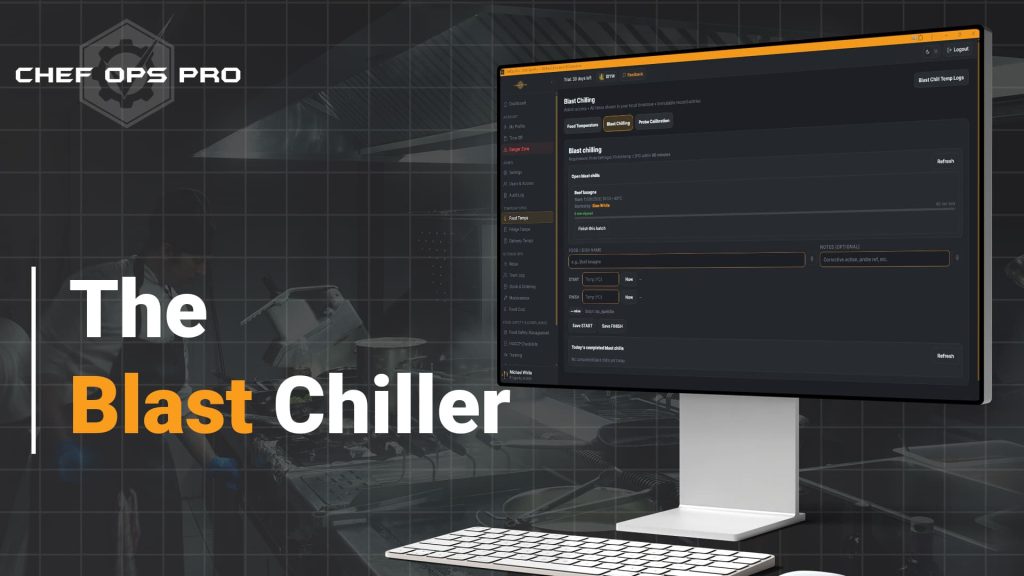
🍴 Speed Chilling Done Right, Every TimeBlast chilling is a critical HACCP control point, and logging it correctly is non-negotiable for food safety compliance. Yet most kitchens still rely on handwritten time stamps on Post-it notes or scraps of paper that vanish before the next inspection. Chef-Ops-Pro's Blast Chill module gives you a clean, timestamped digital record of every cycle.

The Problem
Blast chilling is one of the most scrutinised HACCP control points in any commercial kitchen — and one of the most poorly documented. UK food hygiene law requires cooked food to be cooled as quickly as possible, and official guidance uses 90 minutes as the benchmark — so a kitchen needs a record that shows it was done, every time. In practice, most independent kitchens are still logging blast chill cycles on scrap paper, Post-it notes, or not at all — creating a compliance gap that an EHO inspector will find immediately.
The consequences of inadequate blast chill records go beyond a poor inspection rating. Incorrectly chilled food is a genuine food safety risk, and without a verifiable log, there is no way to demonstrate that safe temperatures were reached within the required window. Chef-Ops-Pro’s Blast Chill module replaces informal paper logging with a structured, timestamped digital record for every cycle, every product, and every machine — making HACCP compliance at this critical control point consistent, auditable, and defensible.
Who This is For
Module compliance & Record Keeping

HACCP-compliant blast chill records that satisfy EHO inspectors
UK food hygiene law requires every food business to run food safety procedures based on HACCP principles, and for most kitchens that cook and chill, cooling is a critical control point — one that needs documented monitoring, corrective action records, and verification evidence. The Food Standards Agency expects food businesses to demonstrate not just that a blast chiller exists, but that it is being used correctly and consistently, and that records are maintained to prove it. Chef-Ops-Pro's Blast Chill module captures start and finish times, product details, batch sizes, starting and completion temperatures, and any corrective actions taken when a cycle exceeds safe time limits — creating a complete, structured HACCP record that requires no additional paperwork and is available instantly during any inspection.
What you can do with this module
Log blast chill start and finish times
with a single tap, capturing the exact duration of each cycle
Record the product, batch size, and starting temperature
so every log tells the complete story
Track completion temperatures
to confirm the food reached safe core temperature within the required time window
Monitor multiple blast chiller units
independently, with separate logs per machine
Flag cycles that exceeded safe time limits,
prompting staff to assess and document any corrective action
Build a complete chilling audit trail
that satisfies EHO inspectors and demonstrates HACCP compliance at every level
Review historical cycles
by date or product to identify patterns, inefficiencies, or repeat issues in your chilling workflow

Not in those exact words. UK food hygiene law requires cooked food to be cooled as quickly as possible, and requires food safety procedures based on HACCP principles. If cooling is a critical control point in your plan — as it is for most kitchens that cook and chill — it needs to be monitored and recorded, and a blast chill log is the clearest way to show an EHO that it is.
The module automatically flags any cycle that exceeded safe time limits, prompting staff to assess the batch and document the corrective action taken. This creates a complete record of the incident and the response — which is exactly what an EHO inspector expects to see.
Staff record both the starting temperature of the product and the completion temperature at the end of the cycle. This confirms the food reached a safe core temperature within the required window and provides the full thermal journey for each batch.
es. All records are stored permanently and can be filtered by date or product, making it straightforward to present a complete chilling history to an inspector on any device without searching through paper logs.
Yes. The module supports both cook-chill and cook-freeze workflows, with logging structured to capture the data points required for each process type.
You Need Answers !
To make an educated decision, you have Questions that need answers
We will try to do that but incase we dont please contact us