
No system does it for you. Not paper. Not ours.
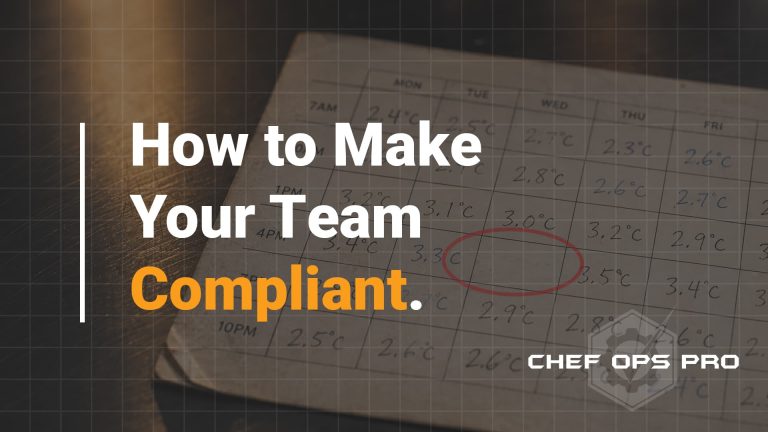
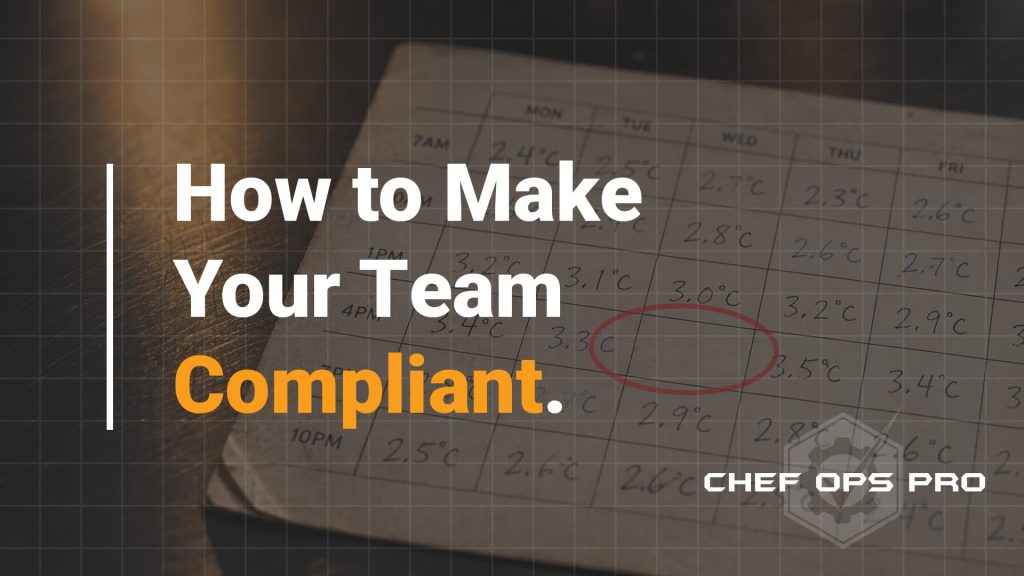
It was a Sunday morning, somewhere around half past nine, and a manager put a fridge log in front of me and asked me to fill in the week.
Not this morning’s reading. The week. Six days of blank boxes in a column that should have been filled in twice a day by three different people, none of whom were in the building. He had a soft pen and a reasonable tone and he wasn’t a bad man. He was a man with an inspection coming and a gap in his paperwork, and he’d arrived at the conclusion that the gap was a paperwork problem.
I said no. I’ve said no more than once over forty years, and every time the conversation goes the same way: a pause, a bit of quiet irritation, and then the discovery that what we were actually discussing was never the log at all.
Because here is the thing that Sunday morning taught me, and it has stayed with me through Hilton kitchens, hotel openings in three countries, a pub of my own, and now a compliance platform I built myself:
The blank boxes were not the failure. They were the receipt for a failure that happened six days earlier, twice a day, while nobody was watching.
The uncomfortable part
I build compliance software for a living. So take this in the spirit it is meant:
Chef-Ops-Pro has never taken a temperature in its life.
It has never opened a fridge door, never probed a chicken thigh, never noticed that the blast chiller was struggling on a Friday, never walked the section at close down. It sits there and waits, exactly like a clipboard sits there and it waits.
A digital system and a paper system fail in precisely the same place: the moment a human being decides that the check is optional. I have seen paper logs filled in on a Sunday for a week that never happened. I have also seen a digital system where somebody stood in the office and entered six readings in ninety seconds from memory, and the memory was generous. The tool did not cause either of those. A standard that had gone soft caused both.
So if you came here for “buy the app and your team becomes compliant” — that post exists on a dozen other websites and it isn’t true on any of them.
What is true is this: the leader is the control. The system only decides whether the leader can see.
The part most operators miss
There is a detail in the Food Hygiene Rating Scheme that almost nobody outside environmental health thinks about properly, and once you see it you cannot unsee it.
Your rating is built from three scores, and lower is better:
- Food hygiene and safety procedures — up to 25
- Structural compliance — up to 25
- Confidence in management and control procedures — up to 30
Read that third line again. The heaviest single component of your food hygiene rating is not your fridges, your surfaces, your extraction or your floor. It is the inspector’s confidence in you.
And it is not a soft, advisory score. Under the scheme, a business can only be awarded a 5 if no individual element scores above 5. Pick up a 10 for confidence in management — records that don’t hold up, a plan nobody can explain, staff who can’t tell the officer what they check or when — and a five-star rating is arithmetically off the table, however spotless the kitchen is.
The EHO is not really scoring your kitchen. They are scoring whether the kitchen runs like this when they aren’t standing in it. The records are simply the evidence they use to decide.
Which means compliance was never a records exercise. It is a management exercise that produces records as a by-product.
So what does the system actually change?
If leadership is the control, why bother with the software at all? Fair question, and it deserves a straight answer rather than a sales pitch.
Leadership is necessary. It is not sufficient. And the two systems differ enormously in what they give a leader to lead with.
Paper hides an omission. Digital surfaces it. A blank box at three o’clock on a Tuesday is invisible. It stays invisible until somebody goes looking — and in most kitchens somebody goes looking the week the inspection is due, by which point you are not managing, you are excavating.
And the delay is the whole problem, because of what happens in the meantime.
The first missed reading is almost always innocent. A delivery landed, a section went down, somebody got pulled onto the pass and the three o’clock check went out of their head. That is not a compliance failure. That is a Tuesday.
What decides whether it stays innocent is whether anybody notices. Because an unnoticed miss is not neutral — it teaches. The cook who forgot learns, without a word being said to them, that nothing happens when you forget. That lesson has now been delivered and it cannot be recalled. The second one comes easier. By the fourth it isn’t forgetting any more, it’s a small private decision made under pressure. By the tenth it is simply how that section runs, and nobody chose it and nobody would defend it — it set, the way a sauce left on the side sets.
Then it travels. Kitchens are imitative places, and the standard people actually follow is not the one on the wall, it’s the one they watch somebody else getting away with. One quiet lapse on one section becomes the ambient temperature of the whole kitchen, and at that point you no longer have a person to correct. You have a culture to reverse.
Digital does not stop the first miss. Nothing stops the first miss. What it does is collapse the distance between the miss and the noticing — from three weeks to one shift. And three weeks is precisely the incubation period a bad habit needs. Catch it on the Tuesday and it is a two-minute conversation with somebody slightly embarrassed and quietly grateful. Find it in the folder in October and you are trying to argue a kitchen out of a habit it has spent a season learning, which has never once worked in the history of the trade.
Paper is retrospectively fixable, and that quietly rots the standard. Everybody in the building knows the log can be filled in on Sunday. The moment your team learns that the record is theatre, they conclude — correctly — that the check behind the record is theatre too. That is not a records problem. It is a standards problem, and it spreads. A timestamped entry removes the option, and when the option disappears the standard becomes real again.
Paper rarely tells you who. “Somebody didn’t do the fridge temps” is a lecture at handover that lands on everyone and changes nobody. A name changes it into a conversation, and conversations are how standards are actually held.
Leadership doesn’t scale by presence. You can only stand in one kitchen at a time. You are not on the late shift on Wednesday, you are not on at all on your day off, and if you run two sites you are permanently absent from one of them. Visibility is how a manager leads the shift they are not on.
None of that makes the software the control. It makes the software the thing that tells the control where to point.
None of this is a kitchen problem
If it’s any comfort, we didn’t invent this.
Jens Rasmussen spent a career studying why careful systems go wrong — nuclear stations, aviation, chemical plants — and reached a conclusion any head chef would recognise. Systems rarely fail because someone is reckless. They drift. There is steady pressure from above to work faster and leaner, and steady pressure from the person actually doing the job to take the path of least effort, and neither of those is irrational. Under that pressure the way a place operates moves, a little at a time, towards the edge of what’s acceptable.
Then comes the part that matters. You cannot see the edge. There is no line painted on the floor. The system gives you no feedback whatsoever while you are drifting towards it — you find out where the boundary was by crossing it, usually with an inspector already standing in your kitchen.
That is a fridge log, described by a safety scientist who had never set foot on a section. Nobody in the kitchen decided to stop checking. The pressure was real, the shortcut was rational, and nothing anywhere pushed back.
Now, this gets misread, so let me be plain about it: none of that means it isn’t somebody’s responsibility. It means it isn’t the cook’s. Rasmussen doesn’t delete accountability, he relocates it — to whoever sets the conditions people work under. In a commercial kitchen, that is you. The pace, the staffing, when the checks fall, what happens when one is missed, whether anybody ever looks. Every one of those is a decision somebody made, or a decision nobody made, which is also a decision.
And his answer was never to lecture people harder about the rules. It was to make the boundary visible while there is still margin left — to give the people doing the work some way of seeing how close to the edge they have drifted, before the edge announces itself.
He wrote that about power stations in the nineteen-nineties. It is, more or less exactly, why I built what I built.
The leadership standard
Here is what I have actually seen work, in kitchens that ran on paper and kitchens that ran on screens. It is the same list either way.
1. Say what the standard is, out loud, once. Most kitchens have never done this. There is an assumption that everyone knows, and there is a HACCP file in a drawer, and between the two sits a large unspoken gap. Name the checks, name the times, name who owns each one. Five minutes, once, in front of everybody.
2. Do it yourself, visibly. If the head chef has never been seen taking a temperature, the team has already worked out where this sits in the hierarchy of things that matter. Nothing you say will outrank what you do in front of them.
Be the Leader you want them to emmulate.
3. Design the check around service, not around the auditor. If your hot-hold check falls at 12:40 on a Saturday, you have designed a failure and then blamed a person for it. Move the check. The best compliance routine is the one that survives a busy Saturday, and if yours only survives a quiet Tuesday it is not a routine, it is a wish.
4. Close the loop within twenty-four hours. Not a weekly audit — a daily glance. Two minutes at close: what’s missing, whose was it, ask them tomorrow. That’s it. The habit you are trying to build in your team will only ever be as reliable as the one you build in yourself, and this is the one that does nearly all the work. Skip it for a fortnight and every other point on this list stops mattering.
5. Never accept a backfill. Not once. This is the one that matters more than the other eight combined. The first time you allow a record to be created after the fact, you have taught the whole team that the record is a story you tell rather than a thing you observed. You cannot un-teach it. Take the honest gap, write down why it happened, and fix the cause. An honest gap with a note beside it reads far better to an inspector than a suspiciously perfect column — they have seen thousands of columns and they know exactly what one written in a single sitting looks like.
6. Attribute everything. Accountability without a name attached is just weather. It happens to everybody and nobody is responsible for it.
7. Make it take under two minutes. Friction is a management decision, not a fact of life. If your check takes eleven minutes and involves finding a pen, a folder and a working probe, your team’s compliance is a measure of their patience, and patience runs out around eight o’clock on a Friday.
8. Notice the log, not only the plate. You have praised a good dish a thousand times. Have you ever thanked somebody for a completed log? What gets noticed is what gets repeated, and at the moment the only feedback most cooks receive about record-keeping is negative and arrives late.
9. Induct agency and casual staff before they touch a probe. Day one, not week three. This is the single most common gap I see, and it is the one an inspector finds fastest — because they ask the newest person in the room.
If you are still on paper
Some very good kitchens still run on paper, and I am not going to be sniffy about it. I ran on paper for most of my career and we were tight.
But be honest about what paper asks of you as a leader, because it asks for more, not less. Paper gives you no alerts, no timestamps, no attribution you can trust and no visibility beyond the shift you are physically standing in. Every one of those has to be replaced by you, in person, consistently, on the days you’d rather not.
So if paper is your system, the leadership standard above is not optional extra credit. It is the whole mechanism. Walk the log at the end of every shift. Initial it yourself. Date your own review, not just the entries. Photograph or scan the week so a flood, a fire or a lost folder doesn’t erase four years of good practice.
Do that faithfully and paper works. Skip it and paper becomes a liability with your signature on it.
What it comes down to
I did not build Chef-Ops-Pro because I thought software makes people careful. Forty years in kitchens cured me of that idea.
I built it because I got tired of finding out about the gap too late to do anything about it except explain it. Because the manager who asked me to fill in that week did not need a better clipboard — he needed to have known on the Tuesday.
Your team will not become compliant because you bought something. They will become compliant when the standard is stated, demonstrated, checked within the day, attributed to a name, and never — not once — quietly backfilled on a Sunday morning.
The system you choose does not change that. It only changes how long it takes you to find out.
Michael White is a chef of forty years and the founder of Chef-Ops-Pro. If any of the above landed a little too close to home, I’d genuinely like to hear about it — I write these from a section, not a marketing department.
Related reading
- Compliance isn’t a checklist, it’s a habit
- The attributes of a chef as a leader
- Why paper food safety records are a liability
- The agency staff training gap
- What EHO inspectors look for
Work out where you’d actually score
Our free Food Hygiene Rating Checker maps your three FHRS scores to the specific areas letting you down — including confidence in management. No sign-up.