
In kitchens without a formal procurement workflow, purchase requests disappear between shifts, between departments, and between people — with consequences that hit service directly.
A 120-cover restaurant was two-thirds through a Saturday evening service when the sous chef called across to the head chef that they were down to their last two portions of the signature main. The item had been on special that night. Both remaining portions went within the next fifteen minutes.
With forty covers still to go through, the signature main had to be eighty-sixed (pulled from service — unavailable for the remainder of the sitting). Front-of-house broke the news to seven tables. Two of those tables had booked specifically because they had eaten the dish before. One left without ordering a replacement.
When the head chef reviewed the situation the following day, the picture became clear. The sous chef on the Thursday prep shift had identified that stock levels of the key ingredient were critically low and had written a purchase request on a slip of paper, left it on the sous chef pass, and mentioned it verbally to the closing manager.
The closing manager had a lot going on. The slip had been moved during cleaning. By Friday morning it had gone. The Tuesday delivery had already been placed. No order was made.
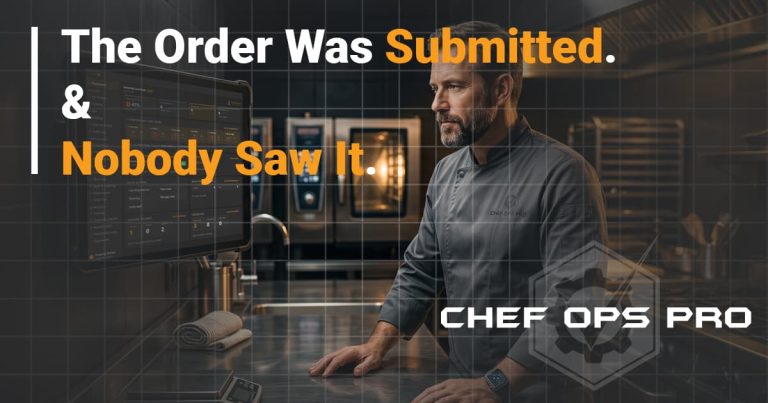
The request had been submitted. Nobody had seen it. The service collapsed anyway.
How Procurement Requests Disappear
This is not an unusual story in commercial kitchens. The informal procurement request — a note on the whiteboard, a message on a group chat, a verbal mention at the shift handover, a slip of paper on the pass — is the dominant method of communicating stock requirements in many hospitality operations.
It works well enough in calm conditions. When the kitchen is busy, when shifts are long, when management attention is distributed across multiple operational priorities, the informal request is structurally unreliable. It depends on the right person seeing it, retaining it, and acting on it before the delivery window closes.
When a request fails to convert into an order, the consequences are visible only in service — when the stock is not there and it is too late to do anything about it.
The Cost of an Informal Procurement System
Beyond the immediate service impact, informal procurement creates a range of operational and financial problems:
Duplicate orders. Without a visible record of what has been requested, different members of the brigade sometimes submit requests for the same items. The result is over-ordering, wasted food cost, and pressure on storage.
Missed requests. The reverse scenario — where a request is never acted on — is the one that causes service failures. In a kitchen where the request exists only as a verbal communication or a piece of paper, there is no mechanism for knowing whether it has been received, acknowledged, or acted upon.
No audit trail for food cost. Understanding why food cost has run high in a given period requires visibility of what was ordered, when, and at what quantity. An informal procurement system leaves no trail that can be reviewed.
Manager time. Chasing down purchase requests, confirming what has been ordered, and reconciling deliveries against requests is a significant administrative burden in kitchens where procurement is managed informally.
What a Formal Procurement Workflow Changes
A digital procurement workflow — where requests are submitted, acknowledged, actioned, and tracked in a single system — changes the structural conditions of the Saturday service collapse.
The sous chef submits the purchase request on Thursday. The request is immediately visible to the manager responsible for ordering. It sits in the system as “pending” until it is approved, rejected, or ordered. If it has not been actioned by Friday morning, it is still visible — still pending — not lost on a slip of paper somewhere on the pass.
The closing manager on Thursday night does not need to remember the verbal mention or find the slip of paper. The request is in the system. The status is clear. The action required is unambiguous.
When the order is placed, the request status updates. The sous chef can see it has been actioned. There is no ambiguity about whether the item is coming.
If the order cannot be fulfilled for whatever reason — supplier issue, delivery timing, budget decision — the rejection is recorded in the system, and the kitchen team can plan around it before service rather than during it.
Procurement as Part of the Broader Operation
Procurement sits within a broader operational system: stock levels are linked to prep requirements, prep requirements are linked to menu planning, menu planning is linked to covers projected for each service. A procurement system that is disconnected from the rest of the operation — whether because it runs on paper or because it lives in a separate system — creates gaps that service pressure eventually exposes.
Chef-Ops-Pro’s Procurement module connects purchase requests directly to the operational workflow. Staff submit requests. Admins approve, order, or reject with a status update. The full request history is visible by property. When a request is pending, it stays visible until it is actioned — it does not disappear between shifts.
The Saturday service collapse began on Thursday, when a request was submitted and disappeared. A digital procurement workflow closes that gap at the point of submission, not at the point of service.