
Blast Chilling in Commercial Kitchens: A Complete Guide
Blast chilling is one of the most effective food safety controls available to a commercial kitchen. It is also one of the most poorly documented. Many kitchens invest in blast chiller equipment but treat it as a convenience rather than a monitored control point — leaving a significant gap in their food safety management system.
This guide covers how blast chilling works, what the regulations require, and how to document it correctly.
What Is Blast Chilling?
A blast chiller rapidly reduces the temperature of cooked or hot food using powerful refrigerated airflow. The goal is to move food through the temperature danger zone — broadly 8°C to 63°C — as quickly as possible, minimising the time in which bacterial growth can occur.
In a conventional refrigerator, a large batch of hot food can take many hours to cool, during which the entire fridge environment is compromised and the food itself remains at risk. A blast chiller can bring the same food from above 70°C to below 3°C in 90 minutes or less, depending on the product, load, and machine.
The Regulatory Framework
The relevant legislation is Regulation (EC) No 852/2004, retained in UK law, which requires food business operators to cool cooked food as quickly as possible after heat treatment. The regulation does not prescribe blast chilling as the only method — but for large-batch cooking operations, it is the standard approach endorsed by the UK Food Standards Agency and the Hazard Analysis and Critical Control Points (HACCP) methodology.
Your HACCP plan should identify cooling as a Critical Control Point (CCP) if you are producing food in advance of service. A CCP requires:
- A defined critical limit (the safe end temperature and maximum time to reach it)
- A monitoring procedure (how you check that the CCP is being met)
- A corrective action procedure (what happens if it is not)
- Records (documented evidence that monitoring took place and what the results were)
Blast chilling is the control measure. Documenting the chill cycle is the record.
Safe Chill Parameters
The Food Standards Agency’s guidance — based on the Chilled Food Association’s standards and food science research — establishes the following benchmark:
Cooked food should be chilled from above 70°C to 3°C or below within 90 minutes.
Some organisations use a slightly different benchmark of chilling to 5°C within 90 minutes, but the 3°C target is the more conservative and widely accepted standard for best practice in a UK context.
These targets should be written into your HACCP plan as the critical limits for your cooling CCP.
What a Blast Chill Record Should Capture
Each blast chill cycle should have a record that includes:
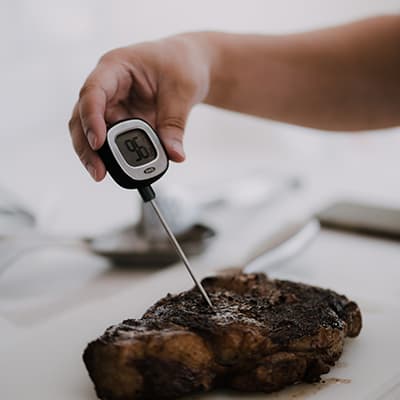
Start temperature — the temperature of the food when it entered the blast chiller. This should ideally be taken with a probe thermometer at the core of the food, not assumed based on the cooking process.
End temperature — the temperature of the food when the chill cycle is complete. Again, a core probe reading is more reliable than the cabinet display alone.
Elapsed time — the time taken to chill from start to end. This is the key compliance figure: was the food chilled within the permitted window?
Date and time — when the cycle occurred.
Product — what food was chilled.
Who performed the check — user attribution for the record.
Corrective action — if the chill cycle exceeded the permitted time or failed to reach the target temperature, what was done with the food?
Common Failures in Blast Chill Documentation
No record at all. The blast chiller is used routinely but no monitoring record exists. In a HACCP assessment, this means the CCP has no evidence of monitoring — which is a significant finding.
Recording cabinet temperature only. The blast chiller’s built-in display shows ambient cabinet temperature, not food core temperature. Recording the display reading without a probe check is not sufficient for a rigorous HACCP record.
No corrective action for failed cycles. If a chill cycle took 3 hours instead of 90 minutes and the record shows only the temperatures with no note of what happened to the food, the record is incomplete and the safety decision — what to do with food that has cooled slowly — is undocumented.
Paper records stored separately from the rest of the FSMS. Blast chill logs kept in a different folder from refrigeration and food temperature records are harder to present as part of a coherent food safety management system during an inspection.
Integrating Blast Chill Monitoring Into Your FSMS
Blast chill records should sit alongside your food temperature logs as part of a unified food safety management system. They follow the same principle: a record of what was measured, when, by whom, and what action was taken when a reading was out of range.
Chef-Ops-Pro includes dedicated Blast Chill Monitoring within the food temperature logging module. Each cycle records start and end temperatures, calculates elapsed time automatically, and checks compliance against your configured target temperature and maximum chill time. Out-of-range cycles are flagged. The full cycle history is stored with user attribution and timestamps.
For operations running large-batch cookery — banqueting, care home catering, contract catering — this provides the documented CCP evidence that HACCP compliance requires.
A Note on Combination Approaches
Blast chilling is not the only cooling method. Some operations use ice baths, blast freezers, or divide food into smaller containers for faster ambient cooling. Each of these can be appropriate, but each requires its own monitoring and record — and each should be validated in your HACCP plan as a control measure that reliably achieves the safe cooling target.
If your cooling process is not blast chilling, the same principle applies: you need a record of what temperature the food was cooled to, how long it took, and who verified it.